






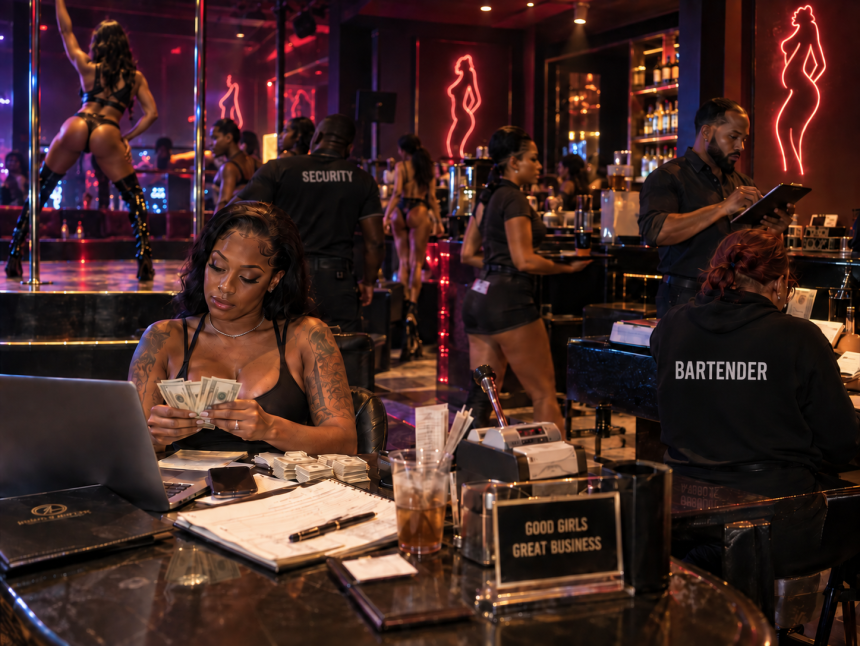
Mention a strip club, and most people immediately think of dancers.
They are not entirely wrong, but they are far from seeing the full picture.
What most people perceive is only the surface: the dim red lighting, the music, the alcohol, and the performances. It is easy to reduce the entire experience to nudity and entertainment. However, beneath that surface lies something far more complex and far more interesting.
At its core, a strip club is not just a venue for performances.
It is a marketplace.
In fact, it is one of the most efficient and dynamic marketplaces in the entertainment industry, one that quietly operates on principles that many modern businesses are still trying to master.
A Strip Club Isn’t Selling Dances
To understand the strip club economy, we must first challenge the most common assumption: that customers are paying for dances.
They are not.
What customers are truly paying for is an environment: an experience carefully designed to evoke specific emotions and perceptions.
They are paying for atmosphere: the lighting, the music, the energy of the room.
They are paying for exclusivity: the feeling of being in a space that is not accessible to everyone.
They are paying for status: the subtle social signals that come with spending money in such an environment.
They are paying for attention, conversation, fantasy, and connection.
The dance itself is only one component of a much larger offering.
The real product is emotional. It is the way the customer feels while they are there.
This is not unique to strip clubs. It is a fundamental principle of hospitality and experience-driven businesses. Restaurants, luxury hotels, and high-end lounges all operate on the same idea: people remember how you made them feel far more than what you technically delivered.
The Club Is the Platform
When viewed through a business lens, the strip club begins to resemble something very familiar: a platform.
Consider companies like Uber or Airbnb. Uber does not own every car, and Airbnb does not own every apartment. Instead, they provide the infrastructure that allows independent participants to connect and transact.
Strip clubs operate in a similar way.
Rather than simply employing dancers in a traditional sense, many clubs create an environment where multiple participants can operate within a shared system. The club provides the venue, security, marketing, music and, most importantly, access to customers.
Within that framework, an entire ecosystem comes to life.
Dancers interact with customers.
Bartenders serve drinks.
DJs control the atmosphere.
Promoters bring in traffic.
Each participant contributes to the overall experience while also pursuing their own income.
This is the essence of a marketplace: a structured environment where supply and demand meet, facilitated by a central platform.
The Dancers Are Entrepreneurs
One of the most overlooked aspects of the strip club economy is the role of the dancers themselves.
Contrary to popular belief, the most successful dancers are not simply performers. They are entrepreneurs.
They build personal brands.
They cultivate relationships with regular customers.
They understand sales psychology and know how to read body language.
They manage their time strategically, choosing when and how to engage.
They know how to upsell experiences and maximize each interaction.
Most importantly, they understand that customers rarely return for a performance alone. They return for the experience: the connection, the familiarity, and the sense of being recognized.
This is, in many ways, an early form of the creator economy.
Long before terms like “personal branding” and “audience monetization” became mainstream, dancers were already building businesses around their personalities, their presence, and their ability to create memorable interactions.
Attention Is the Currency
If there is one lesson that extends beyond the strip club and into nearly every modern industry, it is this: attention is the foundation of revenue.
In a strip club, the stage is not necessarily where the most money is made. Instead, it is where visibility is created.
Visibility leads to curiosity.
Curiosity leads to conversation.
Conversation builds relationships.
And relationships generate repeat business.
This progression mirrors the marketing funnel used in digital industries today. Whether you are a YouTuber, a fitness coach, or a content creator, the principle remains the same.
Attention sits at the top of the funnel.
Trust is where the money is made.
The ability to convert attention into lasting relationships is what separates average performers from top earners, both inside and outside the club.
Not Every Customer Is the Same
Another key insight from the strip club economy is the understanding of customer segmentation.
Not every customer behaves the same way, and not every customer is expected to spend the same amount.
Some customers may buy a single drink and leave.
Others may book VIP tables.
Some tip generously.
Others become loyal regulars who return consistently over time.
Rather than forcing a one-size-fits-all approach, strip clubs are designed to accommodate different spending behaviors. They offer multiple tiers of experience, allowing customers to engage at a level that matches their budget and intent.
This is a strategy widely used in other industries. Airlines offer economy, business, and first-class seating. Streaming platforms provide free and premium tiers. Luxury hotels offer a range of room categories.
The principle is simple: maximize value by meeting customers where they are.
An Economy, Not Just a Business
When viewed holistically, a strip club is not just a single business. It is an interconnected economy.
The club generates revenue.
The dancers generate income.
Bartenders, DJs, security personnel, and promoters all earn within the same ecosystem.
Even external participants, such as nearby food vendors, often benefit from the traffic generated by the club.
This interconnected structure highlights an important point: successful businesses often create opportunities for others to thrive alongside them.
By enabling multiple streams of income within a single environment, strip clubs demonstrate how value can be distributed across an entire network rather than concentrated in one place.
The Real Lesson
You do not need to work in a strip club to learn from its business model.
The most important takeaway is not about nightlife. It is about understanding how value is created and sustained.
Successful businesses focus on creating memorable experiences.
They build platforms that allow others to succeed.
They recognize that attention is valuable, but relationships are what drive long-term revenue.
And they understand that the product itself is often only a small part of the overall value being delivered.
The strip club economy serves as a reminder that some of the most misunderstood industries are also among the most innovative.
To truly understand them, you have to look beyond the surface, beyond the music, the lights, and the assumptions, and examine the systems that make them work.
Before You Go…
Today’s lesson wasn’t really about strip clubs. It was about looking beyond the product and understanding the business.
Here’s your homework:
What’s a business you thought was all fun and easy money until you learned what happens behind the scenes?
Class discussion starts in the comments. 👇